Search This Blog

Showing posts with label Main. Show all posts

Thursday, 4 August 2011

Fleischnakas - Meat rolls from Alsace

After a pot-au-feu, usually we get a lot of leftovers of meat. How to use them? Making Fleischnaka is a yummy recipe! The direct translation would mean "snails of meat", but acutally it is much more like "meat rolls".


Ingredients:
For the stuffing:
Leftovers of Pot-au-Feu meat (cold)
For 500g of meat:
2 eggs
2 shallots
parsil
salt and pepper
For the noodle dough:
500g of flour 
5 eggs
10g of salt
a little bit of water
For the cooking:
A nut of butter
1l. of beef stock or the stock of the pot-au-feu

First prepare the noodle dough. Mix all the ingredients together to get a firm, smooth dough. And keep refrigerated for 2 hours.

Then, prepare the stuffing: Take off the fat from the meat and mince it with the shallots, the parsil.
Mix all together with the eggs, salt and pepper.


After 2 hours, roll out the noodle dough very thin and spread the stuffing on. Then roll it and slice it (3 to 4 cm wide).


Fry each side in butter and then boil into the stock for 20 mins.


It is then ready to eat with the stock as a soup or without just with a salad. Enjoy !
 
With the remaining dough, you can make noodle: just roll out the dough very very thin and cut very thin noodle. Cook into boiling salted water for 10mins. It is yummy with a stew or just with a nut of butter!

Monday, 1 August 2011

A traditional French stew: the Pot-au-feu

The Pot-au-feu is a popular winter dish in France. It is composed of a tasty veggie-beef stock, various beef cuts and veggies. The secret is a very slow, slow cooking... for at least 3 hours.


Ingredients (for 6 servings):
- 3kg beef: brisket, chuch steak, shin, gravy beef and/or blade; use 2 to 3 different cuts (this time I used brisket and shin)
- 6 marrow bones
- 5l. water
- 1 big onion picked with 4 cloves
- 2 garlic cloves
- 4 carots
- 1 or 2 turnip
- 1 white gabbage
- 3 leeks
- 8 potatoes
- 3 baie leaves, thym
- salt

Method:
Wash the meat under cold water and put into a large pot. Cover with cold water. Add the onion, the garlic and the green part of the leeks. Put on the low heat (lid on). Let cook slowly for 2 hours. Every 30 mins, remove the foam.
Salt after one hour. Do not salt the meat or the water before, otherwise the stock will be bland.

Prepare the veggies: peel off the carots and the turnips and chunk them. Chunk also the leeks and the gabbage.
After 2 hours, take the leek out. And add the baie leaves, a pinch of thym and the carots.
10 mins later, the turnips,
10 mins later, the gabbage and the leeks (only the white part). Check the seasoning.
Let cook for 30 to 40 extra mins until the veggies are all cooked.
10 mins before the end of cooking, add the marrow bones.

Boil the potatoes separately.

And now?

As an entry, eat the soup with or without veggie
As a main course, drain the veggies and the meat and serve onto a plate with mustard and/or horseraddish. The marrow is delicious spreaded on a slice of bread with some mustard or just coarse salt.

The leftovers are even tastier (but remove the grease when cold) and can be eaten as they are, warm or cold with a vinaigrette (1 Tbsp mustard, 2 Tbsp oil, 1.5Tps red wine vinegar, salt, pepper).

The leftovers of meat can be used in a shepard pie, in a potato salad, in Fleischnaka  (kind of meat rolls)... many possibilities!!
The stock is very tasty and can be used for your future dishes. I make ice blocks of it so that I can use as much as I need when ever I need (rather than buy stock with preservatives...).

I hope you will enjoy this winter stew! Let me a comment whether you have any question!

Wednesday, 18 May 2011

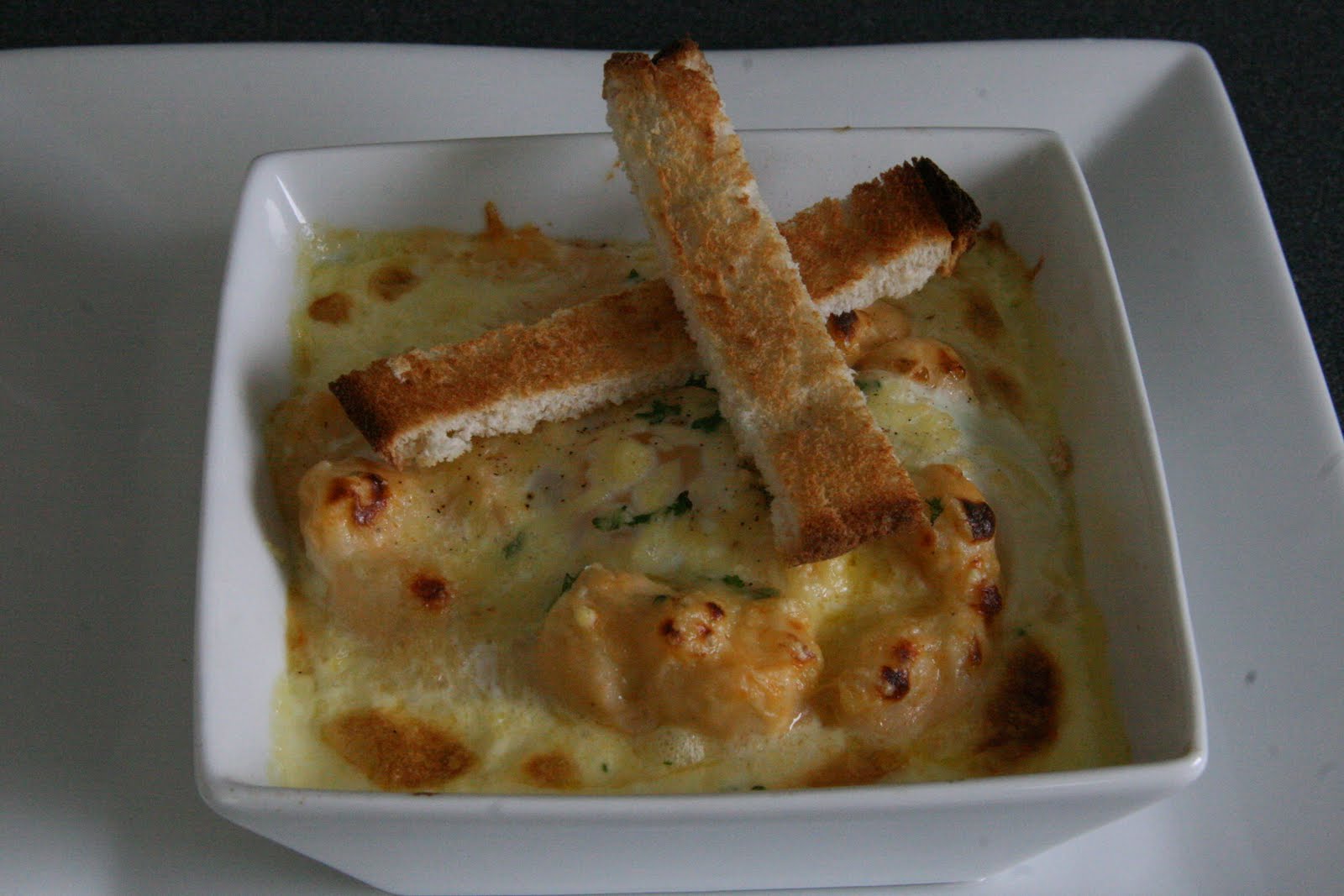
Eggs-cauliflower en cocotte

Today, I want to propose a new recipe of mine. This is a very easy and fast recipe that will wow your guests as an entry or a main. But where would this idea come from? I have no idea at all!
This recipe is an original way to propose cauliflower.
Originally from Asia, the cauliflower is mostly produced in China, India, France, Italy and USA. Usually white, it can be purple or orange (see here).

My recipe also uses a white sauce that is very common in French cuisine.


Ingredients (2 servings)
For the white sauce:
500ml of milk
40g of butter
40g of flour

Method: 
Melt the butter in a hot pot and then mix with flour. Out of the heat, gradually pour the milk and do not stop stirring to avoid lumps. Put it back on the medium heat. Do not stop stirring until you get a nice and smooth texture. When ready, add pepper, salt and nutmeg, a pinch each.


For the eggs en cocotte:
half a cauliflower
500ml white sauce
1 generous tsp tomato paste
1/2 cup of fresh cream
shredded gruyere or any other cheese you like
2 eggs
salt, pepper, parsley
2 toasts

  • Steam the cauliflower for about 15 minutes. It is important that the cauliflower is just slightly undercooked after this stage (as it will finish cooking in the oven).
  • Drain the caulifower and place half of the cauliflower in each cocotte (or ramekin or bowl, just use any dish that goes into the oven).
  • Add 1 tsp of tomato paste into the white sauce and spoon the "rosy" white  sauce over the cauliflower.
  • Mix the cream with salt, pepper and parsley
  • Then spoon the cream over the rosy white sauce (1/4 cup in each dish, just make sure a slight layer of cream cover the white sauce).
  • Break an egg without breaking the yolk and put it down in the dish (one egg in each dish or 2 if very hungry)
  • Salt and pepper (just a little bit)
  • Add the shredded cheese on the top, but avoid to cover the yolk.
  • Bake in the oven for 7 minutes. Be careful, the yolk must still be raw.
Serve with toasts.

Click Here for more nice recipes!

Monday, 2 May 2011

France or Belgium? The Carbonade Flamande

Pic from here

French and Belgian people are always kidding each other, but they really like each other, maybe just like kiwis and Aussies (?) ... Well, humour is just a way to show affection, isn't it?

Grand Place of Bruxelles, Belgium (Pic from here)

Anyway, to avoid some huge debate about the origin of the dish that I am going to introduce to you today, let's say that Northern France and Belgium share at least one famous dish: the Carbonnade Flamande. This is a beef casserole cooked in a beer sauce that is lovely with fries and a pinte of beer, of course! A very easy but tasty dish to make for family or friend events!


Grand Place of Lille, France (pic from here)
Ingredients (6 servings):

1,5kg beef, e.g., blade steack, gravy beef, chunk beef (you can even mix various cuts of the beef)
5-6 onions
40g of butter
3/4 cup of soft brown sugar
3/4 cup of flour
1 liter of blonde beer, e.g., leffe (the better the beer is, the better the dish will be)
6 slices of ginger bread (pain d'épice)
French mustard of Dijon
salt, pepper, baie leaves, thyme

Preparation time: 20 min
Cooking time: 2h30 (the longer it cooks, the better it is!)


Method:

Cut the beef into cubes (4 cm).
Slice the onions.
Heat the butter into a large pot and fry the beef briefly on each side. Then take the meat out of the pot and rest it.

 
Fry the onions into the rest of the butter. When gold, add the soft brown sugar and caramelize a little bit. Then stir the flour in and pour the beer gradually. Do not stop stiring to get a smooth sauce.


Slow down the heat and add the meat, salt, pepper and herbs. Stir and let cook on a very low heat for 45 minutes.


Spread the mustard onto the slices of ginger bread and put them on the top of your casserole after the first 45 minutes, and let cook for 90 minutes, at least. Sti occasionnally, when the slices of ginger bread will be wet enough, they will dissolve into the sauve, giving it a great flavour.
Remember, the longer you let the casserole stew, the smoothest the meat will be. It's even better when reheated the next day.


Serve with french fries or pasta. Enjoy this very friendly dish with the same beer you used for the sauce or with a red wine!

Sorry for this awfull picture! I have messed up my photos ;-)
I'll download a new one the next time I do this recipe! Click here to see nice pictures of the Carbonnade Flamande.

Saturday, 23 April 2011

Red cabbage and beef casserole

Automn is here in NZ, sunny as ever but winter is coming. It's time for dishes that warm you up! Let's go around the Franco-German border, the Rhine Valley, the Vosges and Alsace in France and the Black Forest (Schwarzwald) in Germany.
Farm in the Schwarzwald, Germany (pic found here)
Riquewihr, medieval village, Alsace, France (pic found here)
Farmhouse Ostein, Alsace/Vosges, France (pic found here)


Roasted chestnuts (pic found here)


Around there, automn brings a lot of delicious food that can bring you some comfort during the hard winter time... Chestnuts, which are rosted in the streets, are particularly enjoyed to warm up your hand.


Pic found here
Automn is also the time eat various pork deli food freschly made, e.g., bacon, blackpudding sausages, wieners, pâté... In France, we name it the "Cochonnailles". This is fat but delicious food that gives you everything you need to face the cold winter time.
Pic found here


Today, I propose you to use these ingredients in a red cabbage and beef casserole perfumed with chestnuts and smoked bacon and wieners.


Ingredients (5-6 servings):
1 big red cabbage
1 onion
1 big apple
1+1/2 bowl of fresch chestnuts (or 1 can)
2 smoked wieners (facultative)
250g pieces of bacon (off cuts are very good, but streaky bacon also work)
1kg of chuck steak
25cl of red wine (preferrably Pinot Noir)
15cl of water
1+1/2 Tbsp sugar
3 baie leaves
Thym
Coarse salt
Pepper


Method 

If you are using fresch chestnuts, start preparing the chestnuts. This is a long and fastidious work, so it's preferrably you use a can of already prepared chestnuts, if you can. I have been unable to find one here in NZ, so I used fresch chestnuts. Here is the preparation method:
  1. Incise the shell of each chestnut (make a cross)
  2. Put them into boiling water for at least 20 min
  3. Peel when still warm.
  • At this stage, the chestnuts are only precooked. They will cook with the cabbage later.
 Precook the red cabbage:
Raw cabbage
  • Slice the red cabbage as thin as you can, or it may be better to use a food processor
  • Wash it
  • Put it in a large pot and add water (to cover the cabbage) and 2 pinches of coarse salt
  • Bring it to boil and let it boil for about 20 min. The color will change from flashy purple to dull purple, but the cabbage is still a bit hard.
  • Drain it
  • At this stage, the red cabbage is preccoked.
Precooked


The casserole:
  • Slice the bacon, the onion and the wieners
  • Cut the apple into quarters
  • Cut the steak into 2 or 3 large pieces
  • Heat a large pot with a little bit of oil
  • Stir fry the bacon, the onion and the wieners into. Add some pepper.
  • Add the apple when the onions are brown (not black! hehe ;-))
  • Then add the meat but do not allow it to fall on the bottom of the pot, let the bacon, onion, wieners and apple; 4-5 min each side. Add 2 pinches of coarse salt

  • Add the precooked red cabbage, the herbs, the sugar, the water and the red wine, mix together
  • If using fresch precooked chestnuts: Stew on a low heat for about 20 min, then add the chestnuts and let stew for 40 more min
  • If using a can of chestnuts: Stew on a low heat for about 40 min, then add the chestnuts and let stew for 20 more min
  • Stir occasionnaly and make sure it does not sitck on the bottom of the pot. Add some more water if too dry.
Serve when still hot and enjoy with a glass of your favorite Pinot Noir!


Personnally, I like to eat the meat with a pinch of coarse salt on the top or with some horseradish condiment. But some other people like it with mustard.

Note that the red cabbage can be cooked the same way but without the beef that can be replaced by a roast beef or pork.